RESOURCE · 22/11/2026
Inside Machine Learning and Data
"Garbage in, garbage out" : How AI actually learns and why bad data breaks it.

1. How Machine Learning Actually Works
For anyone wondering what AI and Machine Learning actually are, it comes down to teaching machines to make accurate predictions and classifications using historical data—without hardcoding rules for every possible scenario.
Take a Decision Tree, for example. It works just like a flowchart of yes/no questions:
- Does the email contain spam keywords?
- Is the sender unknown?
- If both are yes, mark it as spam.
Training vs. Testing Data
To build and test models like this, we split our dataset into two parts:
- Training Data: The original examples used to teach the model patterns.
- Testing Data: A separate, unseen set used to check how accurate the model really is.
Watch out for Overfitting: If a model fits the training data too well—essentially memorizing it—but fails on testing data, it is overfitting. Balancing between a model that is too simple (high bias) and one that memorizes noise (high variance) is called the bias-variance tradeoff.
2. Why Data Quality Matters More Than You Think
Even a great algorithm will fail if you feed it flawed data. A famous real-world example is Amazon’s resume-evaluating AI model.
Because it was trained on past hiring data dominated by men, the model learned a gender bias and automatically downgraded resumes containing women-related keywords. The lesson is simple: data quality matters just as much as data size.
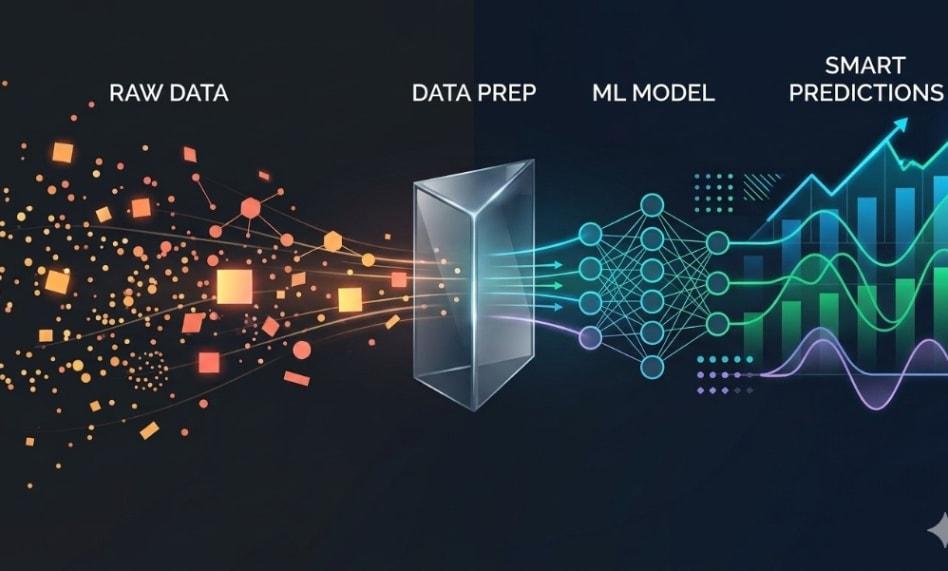
3. The Data Preparation Pipeline
Before training any model, raw data goes through four essential cleanup stages:
A. Labelling
Tagging raw data with the right target answers so supervised models know what to learn (like labelling thousands of photos as "cat" or "dog").
B. Reduction & Cleansing
Making messy datasets smaller and cleaner through:
- Dimensionality Reduction: Compressing many overlapping columns into fewer combined features without losing key info.
- Sampling: Picking a smaller, representative subset from millions of rows.
- Cleaning: Fixing typos, duplicates, and missing entries.
C. Data Wrangling
Shaping clean data so algorithms can process it properly:
- Formatting: Converting dates or text into consistent formats.
- Normalization: Scaling numbers (like age and salary) onto a
0-to-1scale so huge numbers don't dominate.
D. Feature Engineering
Creating smarter input features from existing ones so the model spots better patterns (like multiplying lot length and width to get total area).
The Bottom Line
In a nutshell, Machine Learning and data go hand in hand. Even the smartest algorithm will fail or make biased decisions if we don't prepare clean, fair, and well-structured data first.