BLOG · 16/11/2025
OSCILLOSCOPE ART
Marvel Open day task

OBJECTIVE
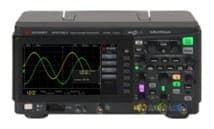
The objective of this project was to showcase the capabilities of the oscilloscope in the Marvel Lab by generating and displaying a unique graphical pattern on it. The idea focused on an innovative method of creating images using sound. Instead of using the oscilloscope to view traditional electrical waveforms, the project demonstrated how stereo audio signals could be transformed into visual art when the oscilloscope was operated in XY mode.
In this technique, each audio channel played a specific role: one channel controlled the horizontal movement (X-axis), while the other controlled the vertical movement (Y-axis). By carefully designing and synchronizing the audio waveforms, it became possible to draw precise shapes, figures, and even animations directly on the oscilloscope screen. Essentially, sound was used as a medium to encode visual information.
PROCESS
1. Image Preparation:
The project began with a chosen image, which was first converted into an SVG (Scalable Vector Graphics) format using a tool called Inkscape. The SVG format was essential because it represented the image as mathematical paths rather than pixels, making it suitable for waveform conversion.
2.Path-to-Audio Conversion:
After obtaining the SVG, its vector paths were converted into stereo WAV audio using a specialized program known as Rabiscopio. This software interpreted the SVG paths and transformed them into corresponding X and Y coordinate waveforms. In the resulting WAV file, the left audio channel represented X-axis data, while the right channel represented Y-axis data.
3.Payback and Oscilloscope Setup:
The generated stereo WAV file was then played through a stereo audio output connected directly to the oscilloscope’s X and Y inputs. When the oscilloscope was switched to XY mode, it used the two audio channels to position the beam across the screen.
4.Real-Time Visualization:
As the audio played, the oscilloscope translated the waveform movements into a drawing that recreated the original SVG image in real time. Depending on the complexity of the audio file, the display could show anything from simple geometric shapes to intricate designs and smooth animations.
CONCLUSION
Overall, this project successfully demonstrated a creative fusion of computer graphics, digital audio synthesis, and analog display technology. By converting visual information into sound and then back into visuals through the oscilloscope, the project illustrated a unique and artistic way of “drawing with audio.” It highlighted how interdisciplinary techniques could transform a scientific instrument into a medium for visual expression and art.